Claude Code
from scratch
A self-paced course: learn how to orchestrate AI coding agents and build real projects.
What you'll actually learn
Knowing a programming language still matters. But this Claude Code course goes one step further — it teaches you to:
Brief a task so the agent does exactly what's needed
Instead of guessing afterwards what it "meant".
Read and understand the code it wrote
So you own the result instead of just hitting "generate".
Assemble it into real, working software
Sites, bots, games — not box-ticking exercises.
All of it serves one goal: a stable, well-paid career in tech that won't fall apart with the next model release.
Sound familiar?
Your job isn't what you love — and it isn't paying well either. The thought "maybe I should move into tech" isn't new. But now the usual doubts ("I'm not technical", "I'm too old", "what if I can't handle it") have a new companion:
is it even worth learning to code now, if AI will be doing it in a couple of years?
You're not racing AI to type code faster — you're learning to be the one who directs it.
It's the one skill in tech that has no "AI will replace it" version, because the skill is working with AI itself.
How the course works


 Tom · Oleg · Anton · and others
The course isn't a lecture library — it's a story. You step into the shoes of Tom, an ordinary guy who has to figure out from scratch how to build real software alongside AI, guided by an experienced mentor, Oleg. 16 levels take you from "what is a terminal" to the discipline practising AI-native developers rely on.
The first steps happen right in the browser, no setup: it's easier to feel what's going on before wrestling with tools. After that it's the real thing — a single installer sets up and configures the IDE, our plugin (it pulls in tasks and submits them for review) and Claude Code, already with our access key.
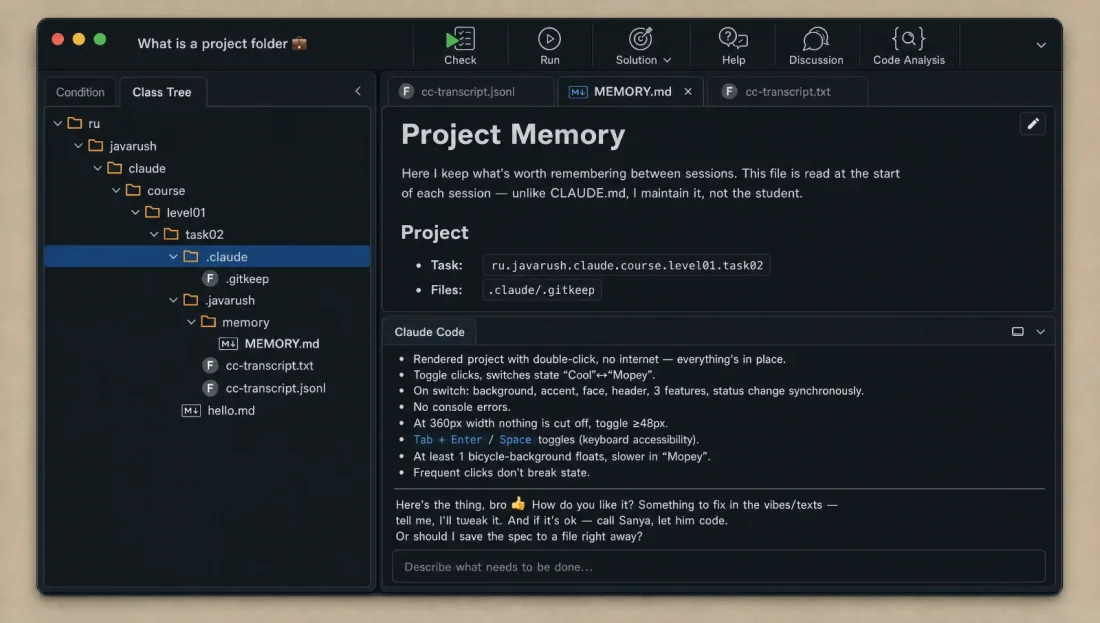
What you'll build
At JavaRush we're obsessed with practice — and as always, the course brings a whole line-up of real projects rather than abstract box-ticking exercises. This time it's arguably even more fun than usual.
First game
You brief an analyst agent — it breaks the task into steps. A coder agent assembles the code. You review the result, and the same day a working browser game is on your screen.
First client
A real client brief and the lesson that vague requirements mean vague results — not in theory, but on a live task.
Tetris
You build the classic — and pick up your first undo button for code, which beats folders named “final-final”.
Snake, but neon
From a plain working version to a striking one — plus your first reusable “skill” for the agent.
A site that lives online
Not “works on my machine” — genuinely opens for anyone, from a link, on any phone.
A second pair of eyes
You teach the agent to find the bug in your own code that its author simply can’t see.
Earthquake radar
The app updates not because you tweaked something, but because something actually happened somewhere in the world. Same technique — a bitcoin tracker.
A bot that runs itself
You set up automation that keeps a decision log without you — “it just happens”, but on a precise schema.
Chess against AI
Through the browser, the agent literally sits down at the board and plays a game on its own while you drink your tea. For once, an opponent that really thinks.
This is where it changes
Two big moments at once. The childhood dream of a world made of blocks stops being out of reach — a voxel 3D world, built step by step with AI, that you can actually walk through, right in the browser. And in the same level you're trusted with a large client portal for the first time, where what's at stake isn't a grade but a result.
From here on, what's behind you isn't practice exercises — it's work you can show in an interview, to an investor, or just to a friend.
And these are only the first 10 of the course's 16 levels. After level 10 real engineering discipline begins — the shift from "works on my machine" to "this can ship to production". What exactly you'll build there, we'll leave as a surprise.
What you get
First tasks run in the browser
No setup, right in the first lesson.
Task review in seconds
With specific requirements and recommendations, not just “right/wrong”.
An AI mentor inside the IDE
It sees your code and your task, knows the whole course — and answers immediately, not a day later on a forum.
200+ hands-on tasks
Real projects: landing pages, bots, games, work with live data.
Claude Code access included
No separate subscription to pay for.
Portfolio-grade artefacts
What you build halfway through the course is the level companies already pay mid-level developer salaries for.
Already sure this is for you? You don't have to read to the end to begin.
Why the usual route doesn't work
If you've already tried breaking into tech on your own or through a typical course, this will sound familiar:
Tons of theory — then the practice task demands something nobody explained.
Feedback is a robot’s “right/wrong”, or a multi-day queue on a forum.
Job promises that sound great, with no specifics on how it actually happens.
AI is either ignored entirely or used as a scare story in the news — with no practical answer on what to do about it.
Here it works differently: results are visible immediately, answers come instantly, and the AI question isn't something we dodge — it's what the entire course teaches.
“Is it really from scratch, or do I need some background?”
From scratch in the literal sense — level one starts with what a terminal is. You don’t need to know anything in advance, you don’t need to code, you don’t even need to know what an AI agent is — the course explains it as you go, never earlier than you need it.
“What if I’m not smart enough and can’t handle it?”
Tom feels exactly the same in his very first session — that’s part of the story, not a sign you’re in the wrong place. Being lost in the first minutes is normal and expected, not a diagnosis.
“What’s the stack? Which languages and technologies?”
That’s not the question to start with here: the AI agent writes the code itself, in whichever language fits the task. Your skill isn’t a specific language but the part that doesn’t expire — briefing precisely, reviewing and understanding the result, running your work through git. Which is exactly why it doesn’t matter what’s fashionable in two years.
“What if I get stuck with no one to ask?”
Inside the development environment, the same AI you’re learning to direct answers any question instantly, at any hour. Not in a day, not on a tutor’s schedule.
“What if all of this is pointless because of AI?”
You’re not racing AI to type code faster — you’re learning to be the person who directs it.
“Is it worth paying if I’m not sure I’ll finish?”
The beginning is completely free — judge for yourself before paying a single dollar.
Where you'll be in a few months
In a few months you haven't just "finished a course" — you have genuinely working projects you built yourself by directing AI. You understand what happens under the hood, you can explain and defend your decisions — and you hold exactly the skill employers are hunting for today.
One click — and the story begins
Nothing to install. Nothing to decide up front. One click and you're in level one, with a real task and an AI agent ready to carry it out.